
The closest consulate is often the wrong consulate. Consulates work by jurisdiction, not convenience, which is why the search most people run, "embassy near me," is the wrong search. The right one is an embassy jurisdiction lookup: your state, your visa type, then the office assigned to both. The office map in our database shows why distance keeps losing to jurisdiction.
What the office map looks like when you count it
Our database holds 150 consular offices in the United States, and they are not spread evenly. Offices sit in only 31 states, plus Washington, D.C., Guam and Puerto Rico; 19 states have no recorded consular office at all. California holds 28 offices, Texas 20, Washington, D.C. 18, New York 16 and Illinois 12. Those five jurisdictions alone account for 94 of the 150 offices, about 63 percent.
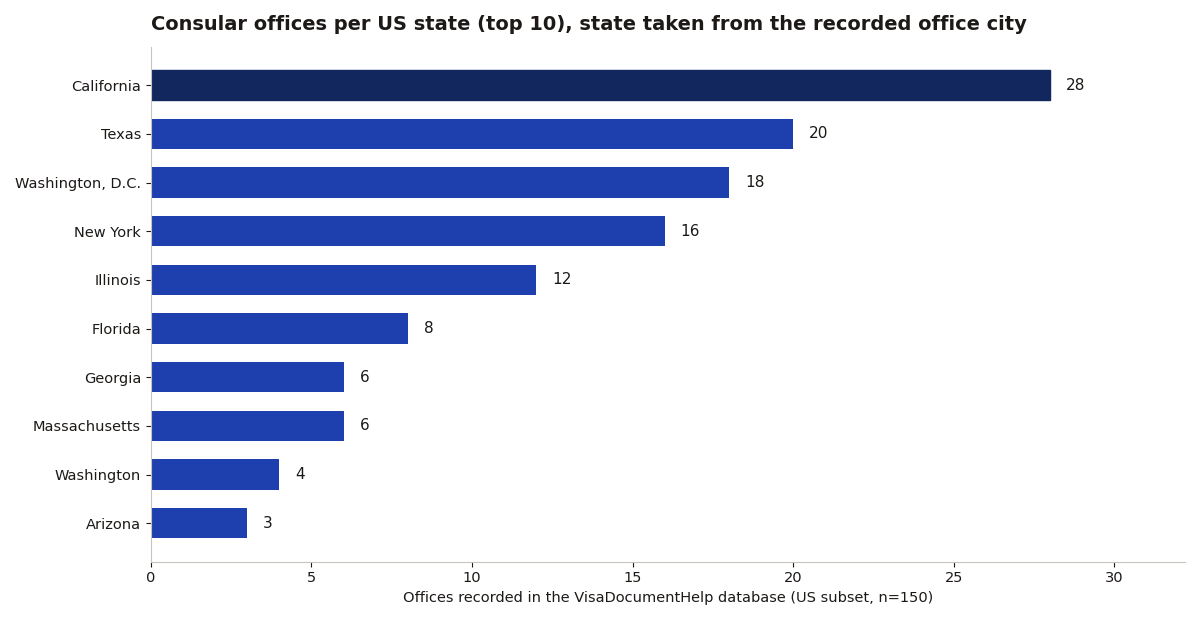
If you live in one of the 19 states with no office, "near me" was never going to work. Your office is assigned, and it may be three states away. Even in a state with offices, the one across town may serve a different region than the one across the state. Apply outside your jurisdiction and the application gets refused or redirected, after you have paid the fee and waited weeks.
A single record shows how wide one office's net can be. Egypt's Houston consulate covers 11 states: Alabama, Arkansas, Colorado, Kansas, Louisiana, Mississippi, Missouri, New Mexico, Oklahoma, Tennessee and Texas. Its Chicago office covers 10 more, from Illinois to the Dakotas. A Houston address on the door tells you nothing about whether the office takes a case from Denver or Little Rock; the jurisdiction list does, and "near" does not. There is a second catch: only 40 of the 150 US offices in our records publish their jurisdiction at all. For the other 110, the lookup ends at the office's own page, which is one more reason to run it before you book, not after.
Jurisdiction first, distance second
The routing rules are not subtle once you look. India's consular services in the US run through VFS Global, and your application must go to the center assigned to your state of residence. Schengen visas go through VFS, BLS, or TLScontact centers by region, not by whichever is nearest. The search to run is not "embassy near me." It is "which consulate serves" plus your state plus the visa type.
One exception keeps the rule honest: US visa appointments in India let you pick among five posts (Delhi, Mumbai, Chennai, Hyderabad, Kolkata), and wait times vary wildly. Hyderabad currently runs about 12 months for B1/B2 while Kolkata is around 6.5. There, the farther office can be the faster one, which is still jurisdiction thinking, just with the wait time added.
The state-by-state picture is starker than the headline numbers. Nineteen states and territories have exactly one recorded consular office, and they share it across every sending country and every visa type their residents need. If that one office is not yours, and for most case types it will not be, your application travels. That is the normal case in this system, not the unlucky one, and it is why a jurisdiction lookup takes two minutes and saves a wasted trip: the office was assigned long before you started searching.
One practical consequence follows. When the assigned office is far away, plan the appointment around the office, not around your week: the fee is paid into that office's process either way, the file sits in its queue either way, and a same-day return trip is a gamble on someone else's counters. The lookup takes two minutes. The wrong office costs a season.
Run the lookup before you book anything
The consulate database search on this site is the lookup in tool form: pick the country, see its US offices, and check the states and regions each one covers. Before you travel, also run the office through Honorary or Real?, because the right jurisdiction with the wrong office type still ends in a wasted trip. Your consular jurisdiction decides which office processes your application; the closest office is usually the wrong one.
Sources: U.S. State Department