
A consulate jurisdiction finder app answers one question: given my address and my visa type, which office processes my application. That sounds simple until you look at what the underlying records actually say. We pulled the office data behind this site's database to see what a finder is really searching, and the honest answer is: a patchy map, where most offices never state their own territory.
What the finder is searching
The database holds 150 consular offices in the United States. Only 40 of them publish the jurisdiction they cover; the other 110, about 73 percent, record no territory at all. Among the 40 that do publish, the spread is wide. Sixteen offices cover exactly one state or region, the median published jurisdiction covers five, and one office, the Philippines in San Francisco, covers 30 states and regions. At the other end, nine offices cover 11 to 20 states or regions each.
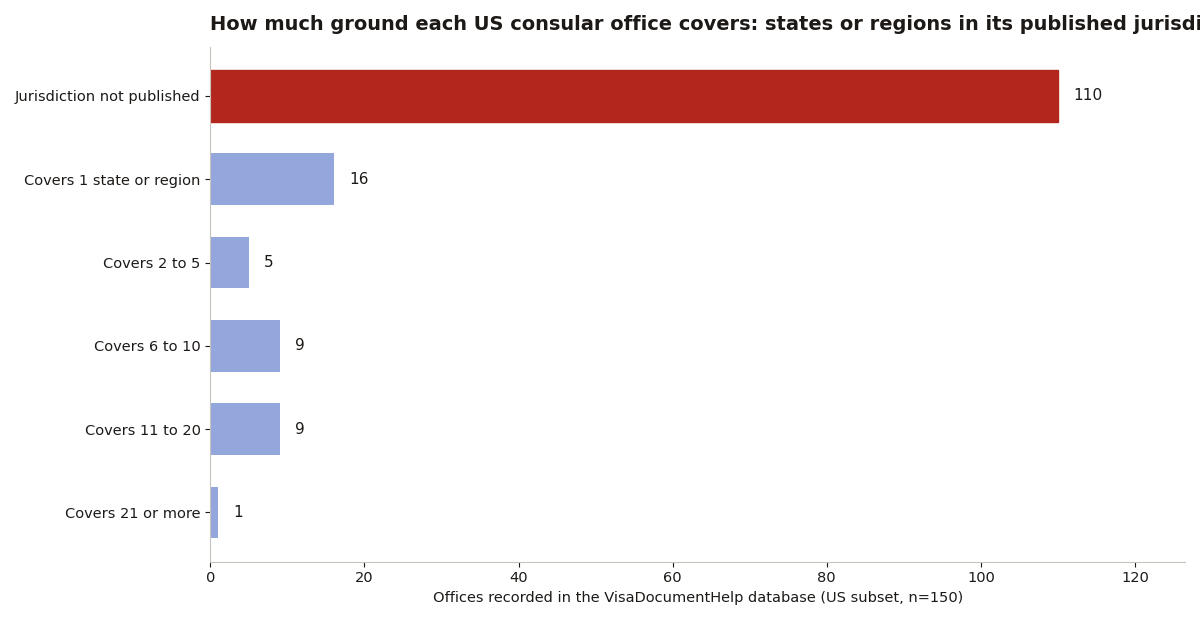
So a good finder app has to handle two kinds of office at once: the kind with a printed territory it can match against your address, and the kind where the territory is confirmed only on the office's own page or by phone. An app that quietly guesses for the second kind is worse than one that admits the gap. The records also do not label office type, which is a separate question from territory, and the one that decides whether the office can take your application at all.
Reading a finder result like a skeptic
Because 110 of the 150 offices publish no territory, many finder results are an inference from the office's city, and city is not jurisdiction. Egypt's office in Houston covers 11 states, most of them nowhere near Texas, while the Philippines' San Francisco office covers 30 states and regions from one California address. A result that names an office is a lead, not an answer. The finder should show you the published jurisdiction where one exists, flag where it does not, and send you to the office's own page for the final word in the second case.
The city list itself is short enough to learn. The 150 US offices sit in 56 recorded cities, and only 18 of them are in Washington, D.C. A finder that indexes embassies in capitals and forgets the consulates in places like Calexico, Presidio and Hagatna will miss exactly the offices that border and island applicants depend on. When the app and the embassy page disagree, the embassy page wins; mappings change when centers open and close, and the app is only as current as its last update.
Even the spelling fights back. The records write the capital two ways, "Washington DC" and "Washington, D.C.", and New York appears as both "New York" and "New York City". A finder that treats those as different cities will show you half an office network and call it complete. Deduplication sounds like plumbing, but in a database built from 22 sending countries' own publications, it is the difference between a map and a pile of pins.
What a good one does, and what it cannot do
What a good one does: maps states to consulates, distinguishes visa types (tourist vs OCI vs passport renewal can have different routing), and links directly to the correct application center. What it cannot do: override jurisdiction. No app can make the wrong consulate accept your application.
The honest version of this tool is a lookup plus a link: your office, the right portal, the current wait time. Anything beyond that is decoration. Check the embassy's own jurisdiction page to confirm what the app tells you, because jurisdiction mappings change when centers open and close. Trust, then verify, then pay the fee.
The two checks to run from your phone
Start with the consulate database search on this site: it is the same office data this article counted, searchable by country and city. Then check the office type against the job with Honorary or Real?, the free checker built for exactly the question a jurisdiction finder leaves open. Territory first, capability second, then the trip.
Sources: U.S. State Department