
You found a consulate. It sits in a directory, or pinned on a map, with an address, a phone number and an official sounding name, and none of that proves the office is what it claims to be, or that it still exists. Directories copy each other. Honorary offices trade under the same word "consulate" as career posts. Real missions close, move and get renamed. A consulate near me result is a lead, not an answer, so check before you go. How to check if a consulate is honorary, renamed or gone comes down to five checks that take about ten minutes at your desk. They are the same checks behind this site's database of embassies and consulates: 1,457 missions run by 22 home countries across 119 host countries, the United States alone hosting 157 of them, verified on September 12 and 13, 2026. Every record in that database is a career post. Honorary consulates were left out on purpose, because general directories mix the two together, and the mix is what sends travelers to the wrong door.
Check 1: Find the office on the sending country's own list
Every foreign ministry publishes an official consulate list: the foreign ministry of the sending country names its own embassies and consulates abroad, usually on its website under missions or representations abroad. Start there, not with the directory that found the office for you. Open the ministry's country page for the place you are in, or search its site for the city. If the office appears, note its exact official title and address. If it appears on no official list, treat the listing as unproven and do not travel to it. That one test answers "is this consulate real" for most listings, because a career post is always on its own ministry's list: the ministry is the body that opened it. Most records in our database rest on official sources of exactly this kind, from GOV.UK and Japan's foreign ministry to the U.S. State Department and China's foreign ministry. 416 of the 1,457 rows, 28.6 percent, rest on Wikipedia mission lists instead, used only where a ministry publishes no usable list of its own, which is itself a hint about how patchy the official record can be.
Check 2: Compare the listing against the official entry
Where the directory and the ministry disagree, believe the ministry. Compare three fields: the address, the phone number and the website. A real mission's website usually sits on a government domain that belongs to the sending country, and its phone number matches the one on the ministry page. A listing that shows a free email address, a mobile number, or an address the ministry page does not show is either stale or copied from a source that was stale before it. Watch for the echo effect as well: three directories agreeing with each other proves nothing, because aggregators copy one another and one old entry can echo for years. One official entry outweighs five copied ones.
Check 3: Read the office's exact title, then get a verdict
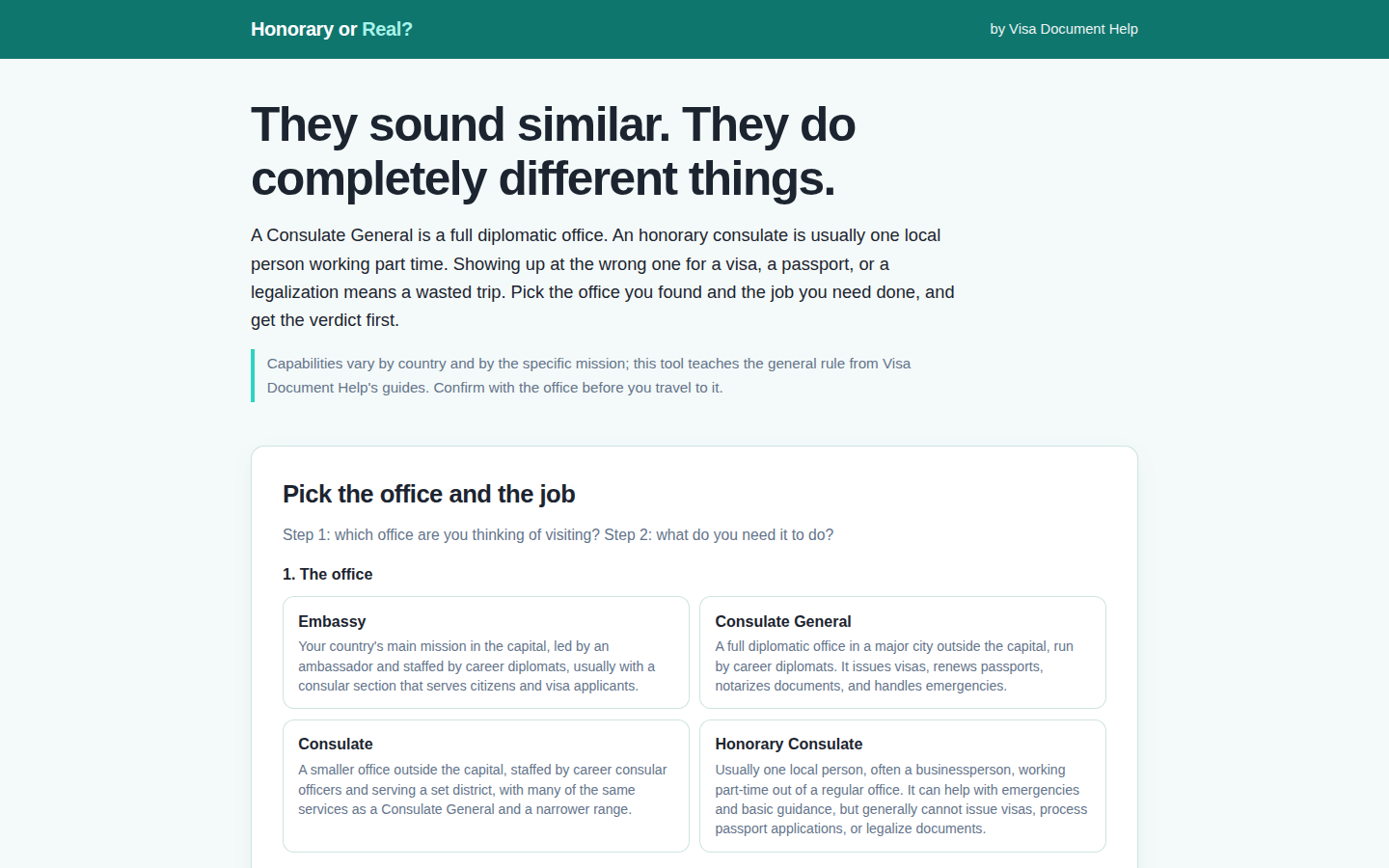
The official list gives the office a precise title: embassy, consulate general, consulate, consular office, or honorary consulate. That title is how to tell an honorary consulate from a career post, whatever the directory headline called it. If the ministry's own list says honorary, the office is honorary, even when a map pin labels it a consulate general. What each title means in practice is a bigger topic, and our guide to honorary consulate vs consulate general covers it in full. Once you hold the office and its real title, run the pair through Honorary or Real?: choose the office type, choose the job you need done, and it returns a straight verdict, can do it, with limits, or cannot do it, with where to go instead. A listing that fails this step is not a dead end. It is directions to the office that can actually help.
Check 4: Confirm your address is inside its district
Career posts serve a set district, and the ministry listing or the office's own page names the states, provinces or regions it covers. Find yours on that list. If your home address falls outside the district, this is not your office, even if it is the closest one and even if it passed every check above. Jurisdiction, not distance, decides where your file belongs. The full lookup, with the district rules and the common traps, is in which consulate serves my state.
Check 5: Make sure it is still open
The last check exists because even true listings rot. Two rows in our own database were live career posts when we verified them in September 2026 and stopped being ordinary consulates within weeks. Germany's consulate general in Saint Petersburg closed on September 17, 2026, after Russia withdrew its consent for the post, and its consular work moved to the German embassy in Moscow. Britain's consulate general in Jerusalem was ordered closed on September 8, 2026, and on October 8 it stopped operating under that name: Israel declared the consulate closed, most of its diplomats left, and the building now works as a smaller UK Mission. A traveler working from a copied listing would still find both offices exactly as described, and both descriptions would be wrong. So before you travel, open the office's own website and the sending ministry's news pages and look for closure, relocation or renaming notices dated after the listing you are trusting. Then confirm the day itself works: hours and holiday closures live in embassy office hours and holiday lists, because a live office that is shut for a holiday wastes the trip just as completely.
Five checks, in order: on the ministry's list, matching the official entry, titled for the job, covering your address, and still open. A listing that fails the first check needs none of the others, and one that passes all five is worth the trip. You can also look any office up in this site's own search, which covers the same September 2026 verified records, before you set out.