
Most consular services for documents start with a hunt for basic facts: which office handles your case, which region it covers, and how to reach it. Whether free or paid help is worth it depends on how findable those facts are. We counted what the office records in our database actually publish, and they publish less than you would expect.
What the records publish, and what they do not
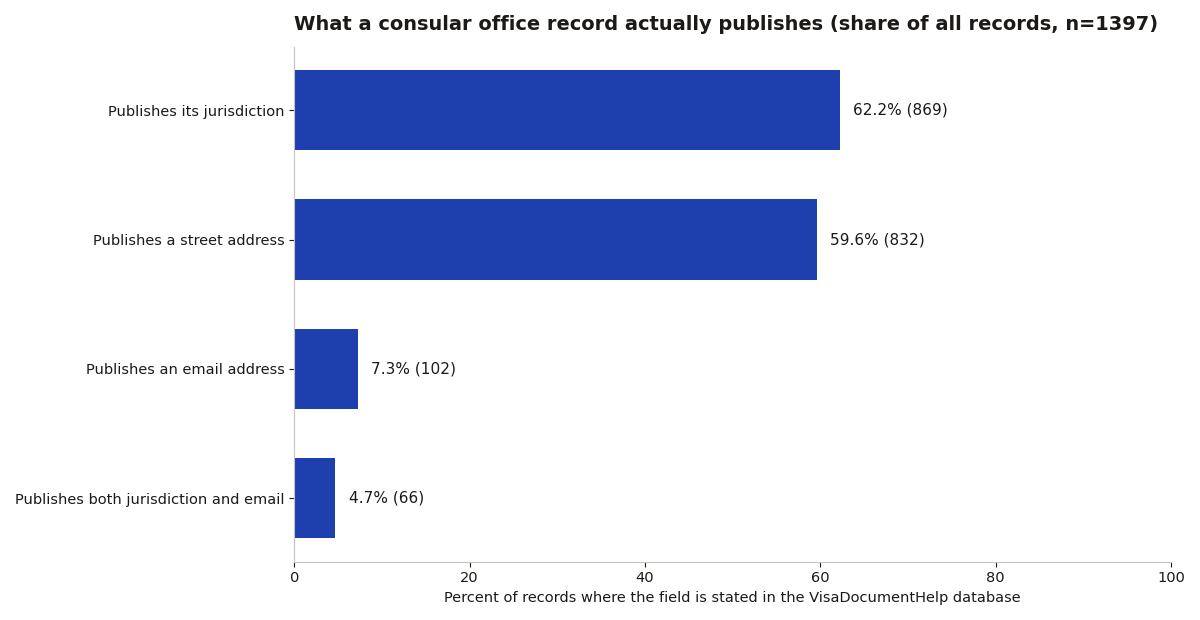
Across 1,397 office records, 62.2 percent publish the jurisdiction the office covers and 59.6 percent publish a street address, but only 7.3 percent publish an email address, and just 4.7 percent publish both a jurisdiction and an email. The US subset is thinner still: of 150 offices in the United States, 40 publish a jurisdiction and only 10 publish an email. And no record in the database states a booking channel or an appointment release pattern at all; that information lives only on each office's own portal.
That is the honest backdrop for the free vs paid question. Paid services have no back door into a consulate. What they sell is watching, organizing and notifying, layered on top of the same published facts everyone else gets. Where the facts are published, free tools do the job. Where they are not, you are paying someone to refresh a portal for you, which is sometimes worth it and often not.
The overlap number is the one to remember. Only 66 of 1,397 records publish both a jurisdiction and an email, and in the US subset the figure is 4 of 150. For the typical applicant, then, the free route looks like this: find the office, read its jurisdiction where one is stated, and use its portal for everything else. Document jobs, legalization, attestation, passport renewal and the like, make the office-type question sharper than for a plain visa, because the wrong type of office cannot take the paperwork at all, published or not.
The gaps go further than email. Some 565 of the 1,397 records do not state a street address either, so for roughly two in five offices the public record cannot even tell you where to show up. None of this is an argument that the offices are unreachable; it is an argument about what you are buying when you pay. You are not buying access or information that others lack. You are buying persistence: someone, or some software, checking the one portal that matters to you more often than you can.
The free methods, and when paid earns its price
Free methods exist: refreshing the scheduling portal yourself, consulate Telegram groups, forums where people post about released slots. They work, slowly, if you have time to stare at a screen. Paid makes sense when the wait is measured in months. Hyderabad's B1/B2 queue is about 12 months; Mumbai 11.5; Delhi 10. At those numbers, $9.99 one-time to get pinged the instant a cancellation opens is trivial math. One caught slot can move your trip up by half a year.
What is not worth it: monthly subscriptions for a one-time problem, services that demand your portal login, and "guaranteed slot" sellers. Nobody can guarantee a government slot. They can only watch faster than you. Pay for speed of notification, not for promises. A push alert in 60 seconds beats a daily email digest every time. SlotAlert, at $9.99 one-time with push alerts for your consulate and visa type and no subscription, is the shape of paid help that makes sense.
So the deciding question is never free or paid in the abstract. It is how long the queue runs at your one assigned office, and what a month of delay costs your plans. Short queue, free wins. Year-long queue and a fixed wedding, course start or contract date, and the paid watcher is the cheapest line in the budget.
Do the free document checks first
Before paying anyone, run the two free checks on this site. The consulate database search tells you which office covers your state or region, where the record states it. Honorary or Real? tells you whether that office type can handle your document job at all. If both check out and the queue is still months long, paid watching is a rational buy. If either fails, no alert subscription will save the trip.
Sources: U.S. State Department